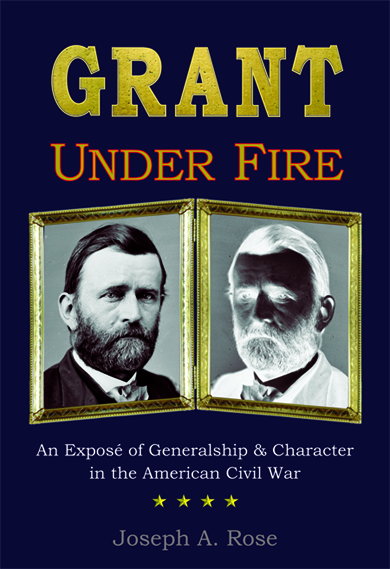
 MEDIA CONTACT:Joseph A. Rose MEDIA CONTACT:Joseph A. RoseAlderhanna Publishing 310 First Avenue #9D New York, NY 10009 (212) 529-1861 josepharose@yahoo.com www.grantunderfire.com ISBN: 978-1943177-004 LCCN: 2015936954 Retail price: $42.50 Illustrations: 37 maps Trim size: 6 x 9 inches Page Count: 816 Binding: Smyth-sewn Cover: Hardbound Cover Art: Four color Publication date: September 15, 2015 | Grant suffered the biggest military surprise of the Civil War, committed the worst official act of anti-Semitism on United States soil, and came closest of all federal commanders to losing Washington, D.C. In ranking his generalship above Robert E. Lee’s, Grant’s defenders ignore his crude, pugnacious strategies that resulted in a costly war of attrition and his amateurish tactics of impetuous frontal assaults against fortified positions. In addition, his cronyism poisoned the Union war effort. Praise from noted Civil War scholars: Joseph Rose presents an engaging critical assessment of Grant’s generalship that is destined to provoke lively debate.—Gordon Rhea Rose writes with a vigorous style, and supports his thesis with impressive research and incisive analysis.—Robert I. Girardi Grant Under Fire reveals a general with a dramatically different character than the one he portrayed for himself.—Lawrence Lee Hewitt A well-written, exhaustively researched essay.—John Horn Rose’s prodigious and impeccable scholarship greatly strengthens his penetrating analysis of both Grant the man and Grant the commander.—William Glenn Robertson Just to set the record straight, there should be more future insightful research and commentary, as you will find here.—Wiley Sword It is a must for any serious student of the Civil War.—Frank Varney This groundbreaking work resolves such persistent controversies as Grant’s drunken partying with the enemy on flag-of-truce boats, unfairly blaming Lew Wallace for the slow march to Shiloh, pretending all along to possess a plan to pass Vicksburg, taking credit for the charge up Missionary Ridge, leaving wounded men to die between the lines at Cold Harbor, and mistreating Black soldiers and civilians. In doing so, Grant’s celebrated Personal Memoirs are shown to be unreliable. Joseph A. Rose spent twelve years writing Grant Under Fire, combining original research—rigorously based on primary sources—and investigative historiography. It overturns 150 years of distorted and untrue accounts of Ulysses S. Grant’s military career and comprehensively debunks his outstanding reputation as an officer and a gentleman. |
Showing posts with label Ulysses S. Grant. Show all posts
Showing posts with label Ulysses S. Grant. Show all posts
Friday, August 14, 2015
Press Release--Grant Under Fire
A book by Joseph A. Rose challenges Ulysses S. Grant’s reputation as a military genius and as a reliable chronicler of America’s bloodiest conflict.


Wednesday, June 3, 2015
New Releases from Southern Illinois University Press
Thanks going out to Southern Illinois University Press for sending along copies of two new releases. The Grant book looks particularly interesting especially since I have failed to read his Memoirs yet.
 Marszalek, John F. editor. The Best Writings of Ulysses S. Grant (The World of Ulysses Grant)
 .
.

 Medford Edna Greene. Lincoln and Emancipation (Concise Lincoln Library).
Marszalek, John F. editor. The Best Writings of Ulysses S. Grant (The World of Ulysses Grant)
.
Famous for his military acumen and for his part in saving the Union during the American Civil War, Ulysses S. Grant also remains known for his two-volume memoirs, considered among the greatest military Memoirs ever written. Grant’s other writings, however, have not received the same acclaim, even though they show the same literary skill. Originally published in the thirty-two volumes of The Papers of Ulysses S. Grant, the letters and speeches are the major source of information about Grant’s life and era and have played a key role in elevating his reputation to that of the leading general of the Civil War and the first of the modern presidents. In this collection, editor John F. Marszalek presents excerpts from Grant’s most insightful and skillfully composed writings and provides perspective through introductory comments tying each piece to the next. The result is a fascinating overview of Grant’s life and career.
In sixteen chronological chapters, selections from Grant’s letters and other writings reveal his personal thoughts on the major events of his momentous life, including the start of the Civil War, the capture of Vicksburg, Lincoln’s reelection, Lee’s surrender, his terms as president, the Panic of 1873, and his bouts of mouth and throat cancer. Throughout, Grant’s prose reveals clearly the power of his words and his ability to present them well. Although some historians have maligned his presidency as one of the most corrupt periods in American history, these writings reinforce Grant’s greatness as a general, demonstrate the importance of his presidency, and show him to be one of the driving forces of the nineteenth century.
With this compendium, Marszalek not only celebrates the literary talent of one of America’s greatest military figures but also vindicates an individual who, for so long, has been unfairly denigrated. A concise reference for students of American history and Civil War enthusiasts as well as a valuable introduction for those who are new to Grant’s writings, this volume provides intriguing insight into one of the nineteenth century’s most important Americans.
In sixteen chronological chapters, selections from Grant’s letters and other writings reveal his personal thoughts on the major events of his momentous life, including the start of the Civil War, the capture of Vicksburg, Lincoln’s reelection, Lee’s surrender, his terms as president, the Panic of 1873, and his bouts of mouth and throat cancer. Throughout, Grant’s prose reveals clearly the power of his words and his ability to present them well. Although some historians have maligned his presidency as one of the most corrupt periods in American history, these writings reinforce Grant’s greatness as a general, demonstrate the importance of his presidency, and show him to be one of the driving forces of the nineteenth century.
With this compendium, Marszalek not only celebrates the literary talent of one of America’s greatest military figures but also vindicates an individual who, for so long, has been unfairly denigrated. A concise reference for students of American history and Civil War enthusiasts as well as a valuable introduction for those who are new to Grant’s writings, this volume provides intriguing insight into one of the nineteenth century’s most important Americans.
Medford Edna Greene. Lincoln and Emancipation (Concise Lincoln Library).
In this succinct study, Edna Greene Medford examines the ideas and events that shaped President Lincoln’s responses to slavery, following the arc of his ideological development from the beginning of the Civil War, when he aimed to pursue a course of noninterference, to his championing of slavery’s destruction before the conflict ended. Throughout, Medford juxtaposes the president’s motivations for advocating freedom with the aspirations of African Americans themselves, restoring African Americans to the center of the story about the struggle for their own liberation.
Lincoln and African Americans, Medford argues, approached emancipation differently, with the president moving slowly and cautiously in order to save the Union while the enslaved and their supporters pressed more urgently for an end to slavery. Despite the differences, an undeclared partnership existed between the president and slaves that led to both preservation of the Union and freedom for those in bondage. Medford chronicles Lincoln’s transition from advocating gradual abolition to campaigning for immediate emancipation for the majority of the enslaved, a change effected by the military and by the efforts of African Americans. The author argues that many players—including the abolitionists and Radical Republicans, War Democrats, and black men and women—participated in the drama through agitation, military support of the Union, and destruction of the institution from within. Medford also addresses differences in the interpretation of freedom: Lincoln and most Americans defined it as the destruction of slavery, but African Americans understood the term to involve equality and full inclusion into American society. An epilogue considers Lincoln’s death, African American efforts to honor him, and the president’s legacy at home and abroad.
Both enslaved and free black people, Medford demonstrates, were fervent participants in the emancipation effort, showing an eagerness to get on with the business of freedom long before the president or the North did. By including African American voices in the emancipation narrative, this insightful volume offers a fresh and welcome perspective on Lincoln’s America.
Thursday, January 30, 2014
Book Review--The Vicksburg Campaign March 29-May 18, 1863
Woodworth, Steven E. and Charles D. Grear, series editors. The Vicksburg Campaign, March 29-May 18, 1863 (Civil War Campaigns in the Heartland). Carbondale: Southern Illinois University Press . 2013. Index, end notes, 9 maps, b/w photos. 239 total pages, 228 pages of text. ISBN 9780809332694, $32.50.

Here in the first of a planned five volume series of essays editors Steven E. Woodworth and Charles D. Grear have gathered a strong, interesting, and for the most part easily read series of pieces. For somebody, such as myself, who has read more on the eastern theater of the war this is a breath of fresh air. I am already eagerly awaiting the second volume and in the mean time will have to search for some of the standard works such as those by Edwin Bearss and Michael Ballard.
Eleven chapters are included in this volume: Gary Joiner writes about the relationship of Ulysses S. Grant and naval commander David Dixon Porter, Charles Grear covers Grierson's cavalry raid, Jason Frawley tells the story of Grant's march along the western side of the Mississippi River and the Battle of Port Gibson, J. Parker Hills covers the May 12 Battle of Raymond, lead editor Steven E. Woodworth tells the story of the battle and first Union occupation of the capital of Mississippi, Jackson, John Lundenberg gives a stinging critique of Joseph Johnston, noted Vicksburg scholar Michael Ballard discusses the relationship of Grant with John McClernand, William B. Feis delves into the subject of intelligence and what did Grant know and how did he obtain that knowledge, Timothy B. Smith (the western theater scholar not the Gettysburg scholar) tells of the Union rout of Confederate forces at Big Black River Bridge, Steven Nathaniel Dossmon tells the story of "hard war" and the interaction of Union troops with locals and the volume wraps up with Paul L. Schmelzer discussing Grant's action at Vicksburg with an eye toward Carl von Clausewitz.
For me the low-light of the book was the closing chapter by Schmelzer. For me it just didn't add anything and I really found myself not caring. As with any anthology like this there will be some writers who grab you more than others and that is certainly the case here. For me however learning as much as I did from this volume pretty well negated my concern about writing styles.
One of the chapters I found most interesting was John Lundenberg and his highly negative view of Joe Johnston. Having read this it seems hard to imagine his being in such a high command position. Any general that would so casually throw a subordinate general and his troops to the wolves as Johnston is said to have done to John Pemberton at Jackson and Champion Hill is not worth his stars.
I also enjoyed Steven Nathaniel Dossmon's story of Grant ordering what is called a "hard war", or having his troops live off the land. In this case it went further than that and it led to all out looting and destruction of much of central Mississippi. This area would no longer be able to supply food, clothing, and other needed items to Confederate troops. Dossman states: "...few other decisions would have a greater impact on the war-making methods employed and the eventual outcome of the conflict." I would add however that total war, making war on citizens and non military areas (the argument would certainly be valid that burning Jackson, a large producer of items for the Confederate war effort, could be called a necessity) leads to a lasting hatred and mistrust of the invader. When soldiers are given carte-blanche to do as they please there are lasting effects that rightly or wrongly do not go away easily. There can be little doubt that Grant's living off the land deflated morale of those in Mississippi and helped keep his troops fed and clothed.
One interesting item I did note while reviewing the Contributors list was that editor Woodworth is a professor at Texas Christian University. Of the eleven contributors six have ties to TCU. I imagine this is due to Dr. Woodworth being familiar with these scholars. They all seemed to have solid credentials and publishing histories so this isn't a knock more just an observation.
Most chapters are around twenty pages so they can easily be read in a single sitting. Many of the chapters include a map which is a must in a book like this. I would have liked to see the maps all be full page however. There are not so many included that this would have added much to the page count. In addition, not all maps list a scale so it is difficult to determine the size of area being displayed or that troops marched.
These are really minor complaints in what is an excellent guide to the start of the Vicksburg campaign. As I said I am looking forward to what Woodworth and Grear put together for future volumes in the series. For those without an in-depth knowledge of the Vicksburg campaign this is highly recommended. If you have read widely on the subject there may not be a lot new for you but I still think it is worth checking out. The individual topics may provide you with new insights.
Thank you to Southern Illinois University Press for sending a complimentary review copy.
. 2013. Index, end notes, 9 maps, b/w photos. 239 total pages, 228 pages of text. ISBN 9780809332694, $32.50.
Here in the first of a planned five volume series of essays editors Steven E. Woodworth and Charles D. Grear have gathered a strong, interesting, and for the most part easily read series of pieces. For somebody, such as myself, who has read more on the eastern theater of the war this is a breath of fresh air. I am already eagerly awaiting the second volume and in the mean time will have to search for some of the standard works such as those by Edwin Bearss and Michael Ballard.
Eleven chapters are included in this volume: Gary Joiner writes about the relationship of Ulysses S. Grant and naval commander David Dixon Porter, Charles Grear covers Grierson's cavalry raid, Jason Frawley tells the story of Grant's march along the western side of the Mississippi River and the Battle of Port Gibson, J. Parker Hills covers the May 12 Battle of Raymond, lead editor Steven E. Woodworth tells the story of the battle and first Union occupation of the capital of Mississippi, Jackson, John Lundenberg gives a stinging critique of Joseph Johnston, noted Vicksburg scholar Michael Ballard discusses the relationship of Grant with John McClernand, William B. Feis delves into the subject of intelligence and what did Grant know and how did he obtain that knowledge, Timothy B. Smith (the western theater scholar not the Gettysburg scholar) tells of the Union rout of Confederate forces at Big Black River Bridge, Steven Nathaniel Dossmon tells the story of "hard war" and the interaction of Union troops with locals and the volume wraps up with Paul L. Schmelzer discussing Grant's action at Vicksburg with an eye toward Carl von Clausewitz.
For me the low-light of the book was the closing chapter by Schmelzer. For me it just didn't add anything and I really found myself not caring. As with any anthology like this there will be some writers who grab you more than others and that is certainly the case here. For me however learning as much as I did from this volume pretty well negated my concern about writing styles.
One of the chapters I found most interesting was John Lundenberg and his highly negative view of Joe Johnston. Having read this it seems hard to imagine his being in such a high command position. Any general that would so casually throw a subordinate general and his troops to the wolves as Johnston is said to have done to John Pemberton at Jackson and Champion Hill is not worth his stars.
I also enjoyed Steven Nathaniel Dossmon's story of Grant ordering what is called a "hard war", or having his troops live off the land. In this case it went further than that and it led to all out looting and destruction of much of central Mississippi. This area would no longer be able to supply food, clothing, and other needed items to Confederate troops. Dossman states: "...few other decisions would have a greater impact on the war-making methods employed and the eventual outcome of the conflict." I would add however that total war, making war on citizens and non military areas (the argument would certainly be valid that burning Jackson, a large producer of items for the Confederate war effort, could be called a necessity) leads to a lasting hatred and mistrust of the invader. When soldiers are given carte-blanche to do as they please there are lasting effects that rightly or wrongly do not go away easily. There can be little doubt that Grant's living off the land deflated morale of those in Mississippi and helped keep his troops fed and clothed.
One interesting item I did note while reviewing the Contributors list was that editor Woodworth is a professor at Texas Christian University. Of the eleven contributors six have ties to TCU. I imagine this is due to Dr. Woodworth being familiar with these scholars. They all seemed to have solid credentials and publishing histories so this isn't a knock more just an observation.
Most chapters are around twenty pages so they can easily be read in a single sitting. Many of the chapters include a map which is a must in a book like this. I would have liked to see the maps all be full page however. There are not so many included that this would have added much to the page count. In addition, not all maps list a scale so it is difficult to determine the size of area being displayed or that troops marched.
These are really minor complaints in what is an excellent guide to the start of the Vicksburg campaign. As I said I am looking forward to what Woodworth and Grear put together for future volumes in the series. For those without an in-depth knowledge of the Vicksburg campaign this is highly recommended. If you have read widely on the subject there may not be a lot new for you but I still think it is worth checking out. The individual topics may provide you with new insights.
Thank you to Southern Illinois University Press for sending a complimentary review copy.
Friday, December 13, 2013
Book Review--Greyhound Commander: John G. Walker's Civil War West of the Mississippi
Lowe, Richard, editor. Greyhound Commander: Confederate General John G. Walker's History of the Civil War West of the Mississippi . Baton Rogue: LSU Press. 2013. Maps, index, bibliography, footnotes. 135 pages, 120 pages of text, ISBN 9780807152508, $36.00.
 If the war in the west is overlooked in comparison to the war in the east the fighting done in the trans-Mississippi area is many times buried and forgotten about without a second thought. First hand accounts written by commanders from the area are rare thus making John G. Walker's work a must read for anybody studying the war in the trans-Mississippi theater of the war.
The book opens with an interesting and easily readable treatment by editor Richard Lowe. Lowe is the author of Walker's Texas Division, C.S.A: Greyhounds of the Trans-Mississippi (Conflicting Worlds: New Dimensions of the American Civil War) and The Texas Overland Expedition of 1863 (Civil War Campaigns and Commanders Series) and is the perfect editor to have taken this work from the vaults at the U. S. Army Military History Institute and presented it to a wider readership
 . Lowe gives readers a nice biographical introduction to John Walker allowing those who do not have a strong background in the trans-Mississippi theater of the war (myself included) to have a better idea of what is going on in Walker's writings.
Walker was an officer in the regular army before resigning in 1861 to join the Confederacy. He began fighting in the east, under Robert E. Lee, earning rapid promotions. He particularly distinguished himself during the Antietam Campaign. By November 1862 however Walker found himself sent westward, a move generally given to those who had failed to meet expectations. Editor Lowe puts forth that this move was probably due to Walker's association with Theophilus H. Holmes, who had served as a mentor and helped Walker receive his promotions. Holmes was a friend of President Jefferson Davis so when Holmes was sent to the trans-Mississippi it is likely that he asked for Walker to be sent west as well. (p. 13) Walker was a division commander in charge of three hard marching brigades of Texans. These men covered hundreds of miles in a short period of time thus earning the nickname "Greyhounds." General Walker was wounded during the Red River Campaign but returned to command later in 1864.
The editing of Walker's text is light with only minor adjustments to the text. First names are added in order to help the reader. It appears that all of Lowe's adjustments are bracketed [ ] for easy spotting. Where Lowe's editorial pen is most evident though are in the large amount of footnotes (yes FOOT notes, no having to flip to the back of the book) that are included. These notes provide readers with further source material, provide information on people and events as need be, and where necessary make corrections and clarifications to Walker's statements.
After having left the United States after the war, due to fear of prosecution, Walker dictated his work to his daughter while they were living in England during 1866-1867. Walker's story begins in 1861 discussing events in Missouri and concludes with the ending of the Red River Campaign in May 1864. The major events covered are the previously mentioned Red River Campaign and the Texas Overland campaign. While the text portion of the book runs 120 pages Walker's narrative is approximately 85 pages long.
A common theme in Walker's writing is a condemning of higher leadership with Edmund Kirby Smith receiving plenty of negative commentary. Walker wrote that had Smith gone after Ulysses Grant's lines between Milliken's Bend and New Carthage Grant would have had to suspend actions against Vicksburg and allow a reinforcement of or an orderly retreat of, Confederate forces. Walker went further in claiming that by John Pemberton not following orders from Joseph Johnston regarding a retreat led to a loss that "was one of the principal links in the chain of misfortune by which the Confederacy was dragged down to failure and ruin." (p. 68). Smith is later condemned during the Red River Campaign for having sent Texas troops to Arkansas instead of leaving them to support Richard Taylor as he followed the retreating Union troops of Nathaniel Banks (p. 101).
While certainly not a complete telling of any of the trans-Mississippi battles this is a resource that should no doubt be consulted. Lowe has included eight maps: the trans-Mississippi theater, Civil War Missouri, Civil War Arkansas, Civil War Louisiana, Battle of Milliken's Bend, Battle of Mansfield, Battle of Pleasant Hill and Battle of Jenkins' Ferry that are a considerable help. Strongly recommended.
Thank you to LSU Press for sending a complimentary review copy.
. Baton Rogue: LSU Press. 2013. Maps, index, bibliography, footnotes. 135 pages, 120 pages of text, ISBN 9780807152508, $36.00.
If the war in the west is overlooked in comparison to the war in the east the fighting done in the trans-Mississippi area is many times buried and forgotten about without a second thought. First hand accounts written by commanders from the area are rare thus making John G. Walker's work a must read for anybody studying the war in the trans-Mississippi theater of the war. The book opens with an interesting and easily readable treatment by editor Richard Lowe. Lowe is the author of Walker's Texas Division, C.S.A: Greyhounds of the Trans-Mississippi (Conflicting Worlds: New Dimensions of the American Civil War)
and The Texas Overland Expedition of 1863 (Civil War Campaigns and Commanders Series) and is the perfect editor to have taken this work from the vaults at the U. S. Army Military History Institute and presented it to a wider readership. Lowe gives readers a nice biographical introduction to John Walker allowing those who do not have a strong background in the trans-Mississippi theater of the war (myself included) to have a better idea of what is going on in Walker's writings.Walker was an officer in the regular army before resigning in 1861 to join the Confederacy. He began fighting in the east, under Robert E. Lee, earning rapid promotions. He particularly distinguished himself during the Antietam Campaign. By November 1862 however Walker found himself sent westward, a move generally given to those who had failed to meet expectations. Editor Lowe puts forth that this move was probably due to Walker's association with Theophilus H. Holmes, who had served as a mentor and helped Walker receive his promotions. Holmes was a friend of President Jefferson Davis so when Holmes was sent to the trans-Mississippi it is likely that he asked for Walker to be sent west as well. (p. 13) Walker was a division commander in charge of three hard marching brigades of Texans. These men covered hundreds of miles in a short period of time thus earning the nickname "Greyhounds." General Walker was wounded during the Red River Campaign but returned to command later in 1864.
The editing of Walker's text is light with only minor adjustments to the text. First names are added in order to help the reader. It appears that all of Lowe's adjustments are bracketed [ ] for easy spotting. Where Lowe's editorial pen is most evident though are in the large amount of footnotes (yes FOOT notes, no having to flip to the back of the book) that are included. These notes provide readers with further source material, provide information on people and events as need be, and where necessary make corrections and clarifications to Walker's statements.
After having left the United States after the war, due to fear of prosecution, Walker dictated his work to his daughter while they were living in England during 1866-1867. Walker's story begins in 1861 discussing events in Missouri and concludes with the ending of the Red River Campaign in May 1864. The major events covered are the previously mentioned Red River Campaign and the Texas Overland campaign. While the text portion of the book runs 120 pages Walker's narrative is approximately 85 pages long.
A common theme in Walker's writing is a condemning of higher leadership with Edmund Kirby Smith receiving plenty of negative commentary. Walker wrote that had Smith gone after Ulysses Grant's lines between Milliken's Bend and New Carthage Grant would have had to suspend actions against Vicksburg and allow a reinforcement of or an orderly retreat of, Confederate forces. Walker went further in claiming that by John Pemberton not following orders from Joseph Johnston regarding a retreat led to a loss that "was one of the principal links in the chain of misfortune by which the Confederacy was dragged down to failure and ruin." (p. 68). Smith is later condemned during the Red River Campaign for having sent Texas troops to Arkansas instead of leaving them to support Richard Taylor as he followed the retreating Union troops of Nathaniel Banks (p. 101).
While certainly not a complete telling of any of the trans-Mississippi battles this is a resource that should no doubt be consulted. Lowe has included eight maps: the trans-Mississippi theater, Civil War Missouri, Civil War Arkansas, Civil War Louisiana, Battle of Milliken's Bend, Battle of Mansfield, Battle of Pleasant Hill and Battle of Jenkins' Ferry that are a considerable help. Strongly recommended.
Thank you to LSU Press for sending a complimentary review copy.
Saturday, June 29, 2013
Book Review--Grant at Vicksburg: The General and the Siege

 Ballard, Michael B. Grant at Vicksburg: The General and the Siege. Southern Illinois University Press. 196 pages, 172 pages text, Index, notes, bibliographic note, maps, b/w photos. ISBN 9780809332403, $32.95.
For those of us not overly familiar with the siege at Vicksburg there really doesn't seem to be some of the standards such as there are with its time partner the Battle of Gettysburg. For the later most will refer a reader to Coddington, or Sears, or Trudeau or maybe John Hoptak's new book. For Vicksburg however: where to begin. I would have to say that Michael Ballard's Grant at Vicksburg: The General and the Siege is not a bad place to start. It isn't loaded down with detail so the reader doesn't get lost but it also is not watered down to where you feel you are reading a book for teens. There is more than enough here to whet the appetite to learn more!
Ballard starts with a brief outline of the two separate attacks on the city that happened in May, 1863. The Confederates might have had 33,000 men available but Grant countered with 35,000 plus the potential for reinforcements. The Confederates held the better fighting positions as is shown by the map outlining the Redoubts and Redans surrounding Vicksburg. What the Confederates did not have however was an escape plan and an executable plan to restock provisions. Grants effective use of David Dixon Porter and the Union navy helped assure the longer term success of the siege strategy.
Overall Ballard does an effective job of balancing biography and history. He paints an overall interesting portrait of Grant. Ballard spends considerable length dismantling the long held story told by Sylvanus Cadwallader about Grant's drunken time on the Yazoo River. He also takes authors to task for not having done proper research on this subject.
Grant's leadership is shown from two different sides. In race relations he is shown as generally strong requiring equal discipline for black and white soldiers. While yes Grant did separate black and white regiments and often used contraband labor for digging we have to remember the time he lived in. Freedom did not mean equality. While strong here, Grant is seen as somewhat a "nervous Nellie" when it came to Joseph Johnston. He is shown as having a constant concern about Johnston and where he might strike and the number of troops he had. In the end Johnston is a non-factor that appears to have not had any intention of becoming involved in the siege or in helping Pemberton and his men.
John McClernand plays an important role during the siege and the interplay between he and Grant is important. Ultimately, despite not being kept completely up to date, McClernand is held responsible by Grant for many of the losses before the siege and is replaced by a General who does not seem completely up to the task at hand; E. O. C. Ord. Ord is at times portrayed as almost a comical thorn in Grant's side.
The siege is ended through the digging of mine trenches to damage the main Confederate redan. Once breached a second time Confederate General John Pemberton had little choice to but propose an armistice and negotiate surrender terms. The terms were generous to the men from the south with officers being allowed to take their side gun, clothing, Field Staff and Cavalry officers were allowed to take a horse, enlisted men were only allowed their clothing. The men were paroled, meaning they were not to return to battle until officially exchanged for Union prisoners. While controversial this relieved Grant of having to feed, shelter, and transport large numbers of Confederates. This freed him and his troops to be sent elsewhere.
According to Ballard Grant leaves Vicksburg a changed man and he concludes his work discussing the ways in which Grant has grown and improved as a general from this campaign. These traits would lead to his becoming commanding general of all armies and then later the president.
This is a short book with less than 200 pages of text. It reads quickly and Ballard is a good writer. The book could have been improved by including a formal bibliography rather than just a bibliographic note. There are complete end notes however for those wishing to validate any of the author's statements. I found myself often having to flip back to the main map located at the start of the book so I would have liked to see a few more maps to help keep me oriented. While maybe not agreeing with all the scholarship that has come before, Ballard has written a book that should be read by anybody with an interest in what happened in the west in July, 1863.
Thank you to Southern Illinois University Press for sending a complimentary review copy.
Friday, April 19, 2013
New Release--Grant at Vicksburg

 Thanks going out to the Southern Illinois University Press for sending along a copy of their new release Grant at Vicksburg: The General and the Siege. The book is written by Michael Ballard who has previously written on Grant, Vicksburg, and Mississippi in the Civil War.
From the publisher:
On May 22, 1863, after two failed attempts to take the city of Vicksburg by
assault, Major General Ulysses S. Grant declared in a letter to the commander of
the Union fleet on the Mississippi River that “the nature of the ground about
Vicksburg is such that it can only be taken by a siege.” The 47-day siege of
Vicksburg orchestrated by Grant resulted in the eventual surrender of the city
and fulfilled a major strategic goal for the Union: command of the Mississippi
River for the remainder of the war. In this revealing volume, Michael B. Ballard
offers the first in-depth exploration of Grant’s thoughts and actions during
this critical operation, providing a never-before-seen portrait of the general
in the midst of one of his most notable achievements.
After an overview of Grant’s early Civil War career from his first battle through the early stages of the attacks on Vicksburg, Ballard describes in detail how Grant conducted the siege, examining his military decisions, placement of troops, strategy and tactics, engineering objectives, and relationships with other officers. Grant’s worried obsession with a perceived danger of a rear attack by Joseph Johnston’s Confederate army, Ballard shows, affected his decision making, and shows how threats of Confederate action occupied more of Grant’s time than did the siege itself.
In addition, Ballard soundly dispels a false story about Grant’s alleged drinking binge early in the siege that has been taken as truthful by many historians, examines how racism in Grant’s army impacted the lives of freed black people and slaves in the Vicksburg area, and explores Grant’s strained relationship with John McClernand, a politically appointed general from Illinois. The book concludes with the surrender of Vicksburg on July 4, 1863, the expulsion of Johnston and his army from the region, and demonstrates the impact of the siege on the outcome on the short and long-terms of Grant’s military career.
By analyzing Grant’s personality during the siege and how he dealt with myriad issues as both a general and an administrator, Grant at Vicksburg offers a revealing rendering of the legendary general.
After an overview of Grant’s early Civil War career from his first battle through the early stages of the attacks on Vicksburg, Ballard describes in detail how Grant conducted the siege, examining his military decisions, placement of troops, strategy and tactics, engineering objectives, and relationships with other officers. Grant’s worried obsession with a perceived danger of a rear attack by Joseph Johnston’s Confederate army, Ballard shows, affected his decision making, and shows how threats of Confederate action occupied more of Grant’s time than did the siege itself.
In addition, Ballard soundly dispels a false story about Grant’s alleged drinking binge early in the siege that has been taken as truthful by many historians, examines how racism in Grant’s army impacted the lives of freed black people and slaves in the Vicksburg area, and explores Grant’s strained relationship with John McClernand, a politically appointed general from Illinois. The book concludes with the surrender of Vicksburg on July 4, 1863, the expulsion of Johnston and his army from the region, and demonstrates the impact of the siege on the outcome on the short and long-terms of Grant’s military career.
By analyzing Grant’s personality during the siege and how he dealt with myriad issues as both a general and an administrator, Grant at Vicksburg offers a revealing rendering of the legendary general.
Sunday, November 13, 2011
Book Review-Grant's Final Victory
Flood, Charles Bracelen. Grant's Final Victory: Ulysses S. Grant's Heroic Last Year . Da Capo Press, Cambridge, MA. 320 pages, b/w photos, notes, bibliography. ISBN 9780306820281, $27.50.*
 There are certain people in the world who seem to achieve success no matter what obstacle is thrown in their way. Ulysses S. Grant is an example of this type person. Charles Bracelen Flood has chosen to focus on the final turbulent year of Grant's life. In doing so he paints a picture of Grant who despite many set backs in his last year of life rises above the occasion to yet again leave his mark on the world.
In the early 1880's Grant seemingly had the world in his hands. He was the victor of the Civil War, having defeated the great Robert E. Lee. He was the former president of the United States. He and his wife Julia moved to a nearly $100,000 townhouse in New York City after having returned from a yearlong tour of the world where he was met with adulation. He was a partner in the seemingly successful financial firm of Grant & Ward.
This partnership would be the financial undoing of Grant and many others as the 40% dividends that were being paid were lies. Grant had been caught in what now is called a Ponzi scheme. Author Flood does an admirable job of explaining what happened and the resulting fall out. Faced with financial ruin many offers came to Grant in his time of need. Attempts were made in Congress to restore Grant's rank of General (forfeited when he became President) that would allow him to receive pension benefits. Individuals from across the country sent donations to the Grant family, many of these coming from soldiers he had led in battle just a few years prior. Perhaps most important was Century Magazine and their offer to publish first hand war articles from Grant.
Unknown to Grant however was that his biggest challenge was yet to come. Cancer. Grant had been a cigar smoker for years and after finally going to the doctor for a pain in his throat was diagnosed with inoperable cancer of the tongue. This diagnosis coupled with the Grant family financial situation set in motion the last great challenge of Grant's life.
Here, author Charles Flood does an excellent job of describing the struggles of Grant's last year. Eventually Grant decides he must write his memoirs in order to take care of his debts and to provide income for Julia. He finally decides on a company owned by Mark Twain to publish his work. The rest of the book traces the painful journey of Grant's last months. With the help of others he wrote on average 750 words a day despite his worsening condition that forced a move to the private cottage of Joseph Drexel at Saratoga Springs, NY. In the face of his declining health he completed his work just three days before passing away on July 23, 1885.
In my view Flood leaves it to the reader to decide what is Grant's REAL final victory. Was it finishing his memoirs before cancer was able to take his life? Perhaps it was being able to repay his obligations and also leave income for his wife and family? His memoirs eventually brought the Grant family over $600,000. Could it have been the respect and admiration shown to the General from soldiers and civilians from both sides of the "late unpleasantness"? Possibly it is just the story of triumph over adversity? I highly suggest reading this book and make your own determination.
This is a book that will appeal to a wide range of readers. Those interested in the Civil War and it's participants will no doubt find this of interest. Those with an interest in Presidential history should take a look as well. For readers who like an uplifting story with a positive message this is a book for you. For book clubs there is much to discuss and Grant's Final Victory would make an ideal read.
*Information here is taken from other sources. A complimentary advance reading copy was provided by Da Capo Press. My copy did not include completed page information.
. Da Capo Press, Cambridge, MA. 320 pages, b/w photos, notes, bibliography. ISBN 9780306820281, $27.50.* There are certain people in the world who seem to achieve success no matter what obstacle is thrown in their way. Ulysses S. Grant is an example of this type person. Charles Bracelen Flood has chosen to focus on the final turbulent year of Grant's life. In doing so he paints a picture of Grant who despite many set backs in his last year of life rises above the occasion to yet again leave his mark on the world.In the early 1880's Grant seemingly had the world in his hands. He was the victor of the Civil War, having defeated the great Robert E. Lee. He was the former president of the United States. He and his wife Julia moved to a nearly $100,000 townhouse in New York City after having returned from a yearlong tour of the world where he was met with adulation. He was a partner in the seemingly successful financial firm of Grant & Ward.
This partnership would be the financial undoing of Grant and many others as the 40% dividends that were being paid were lies. Grant had been caught in what now is called a Ponzi scheme. Author Flood does an admirable job of explaining what happened and the resulting fall out. Faced with financial ruin many offers came to Grant in his time of need. Attempts were made in Congress to restore Grant's rank of General (forfeited when he became President) that would allow him to receive pension benefits. Individuals from across the country sent donations to the Grant family, many of these coming from soldiers he had led in battle just a few years prior. Perhaps most important was Century Magazine and their offer to publish first hand war articles from Grant.
Unknown to Grant however was that his biggest challenge was yet to come. Cancer. Grant had been a cigar smoker for years and after finally going to the doctor for a pain in his throat was diagnosed with inoperable cancer of the tongue. This diagnosis coupled with the Grant family financial situation set in motion the last great challenge of Grant's life.
 |
| Grant writing his memoirs. Photo: Library of Congress |
In my view Flood leaves it to the reader to decide what is Grant's REAL final victory. Was it finishing his memoirs before cancer was able to take his life? Perhaps it was being able to repay his obligations and also leave income for his wife and family? His memoirs eventually brought the Grant family over $600,000. Could it have been the respect and admiration shown to the General from soldiers and civilians from both sides of the "late unpleasantness"? Possibly it is just the story of triumph over adversity? I highly suggest reading this book and make your own determination.
This is a book that will appeal to a wide range of readers. Those interested in the Civil War and it's participants will no doubt find this of interest. Those with an interest in Presidential history should take a look as well. For readers who like an uplifting story with a positive message this is a book for you. For book clubs there is much to discuss and Grant's Final Victory would make an ideal read.
*Information here is taken from other sources. A complimentary advance reading copy was provided by Da Capo Press. My copy did not include completed page information.
Thursday, May 20, 2010
Ulysses S. Grant papers now online
I was catching up on my blog reading and came across a post I wanted to repost. Thanks to Nick Kurtz at Battlefield Wanderings for pointing out that the Ulysses S. Grant papers are now online courtesy of the Mississippi State University Libraries. This should be a huge help to anyone researching Grant. Of course there's nothing like holding a real honest to goodness book but let's face it the papers are over 30 volumes now at roughly $100 each. I think for most of us the online version is a much friendlier option.
Subscribe to:
Posts (Atom)