Showing posts with label Slavery. Show all posts

Wednesday, June 3, 2015

New Releases from Southern Illinois University Press

Thanks going out to Southern Illinois University Press for sending along copies of two new releases. The Grant book looks particularly interesting especially since I have failed to read his Memoirs yet.

Marszalek, John F. editor. The Best Writings of Ulysses S. Grant (The World of Ulysses Grant) .
Famous for his military acumen and for his part in saving the Union during the American Civil War, Ulysses S. Grant also remains known for his two-volume memoirs, considered among the greatest military Memoirs ever written. Grant’s other writings, however, have not received the same acclaim, even though they show the same literary skill. Originally published in the thirty-two volumes of The Papers of Ulysses S. Grant, the letters and speeches are the major source of information about Grant’s life and era and have played a key role in elevating his reputation to that of the leading general of the Civil War and the first of the modern presidents. In this collection, editor John F. Marszalek presents excerpts from Grant’s  most insightful and skillfully composed writings and provides perspective through introductory comments tying each piece to the next. The result is a fascinating overview of Grant’s life and career.


In sixteen chronological chapters, selections from Grant’s letters and other writings reveal his personal thoughts on the major events of his momentous life, including the start of the Civil War, the capture of Vicksburg, Lincoln’s reelection, Lee’s surrender, his terms as president, the Panic of 1873, and his bouts of mouth and throat cancer. Throughout, Grant’s prose reveals clearly the power of his words and his ability to present them well. Although some historians have maligned his presidency as one of the most corrupt periods in American history, these writings reinforce Grant’s greatness as a general, demonstrate the importance of his presidency, and show him to be one of the driving forces of the nineteenth century.


With this compendium, Marszalek not only celebrates the literary talent of one of America’s greatest military figures but also vindicates an individual who, for so long, has been unfairly denigrated. A concise reference for students of American history and Civil War enthusiasts as well as a valuable introduction for those who are new to Grant’s writings, this volume provides intriguing insight into one of the nineteenth century’s most important Americans.


Medford Edna Greene. Lincoln and Emancipation (Concise Lincoln Library).


In this succinct study, Edna Greene Medford examines the ideas and events that shaped President Lincoln’s responses to slavery, following the arc of his ideological development from the beginning of the Civil War, when he aimed to pursue a course of noninterference, to his championing of slavery’s destruction before the conflict ended. Throughout, Medford juxtaposes the president’s motivations for advocating freedom with the aspirations of African Americans themselves, restoring African Americans to the center of the story about the struggle for their own liberation.

Lincoln and African Americans, Medford argues, approached emancipation differently, with the president moving slowly and cautiously in order to save the Union while the enslaved and their supporters pressed more urgently for an end to slavery. Despite the differences, an undeclared partnership existed between the president and slaves that led to both preservation of the Union and freedom for those in bondage. Medford chronicles Lincoln’s transition from advocating gradual abolition to campaigning for immediate emancipation for the majority of the enslaved, a change effected by the military and by the efforts of African Americans. The author argues that many players—including the abolitionists and Radical Republicans, War Democrats, and black men and women—participated in the drama through agitation, military support of the Union, and destruction of the institution from within. Medford also addresses differences in the interpretation of freedom: Lincoln and most Americans defined it as the destruction of slavery, but African Americans understood the term to involve equality and full inclusion into American society. An epilogue considers Lincoln’s death, African American efforts to honor him, and the president’s legacy at home and abroad.

Both enslaved and free black people, Medford demonstrates, were fervent participants in the emancipation effort, showing an eagerness to get on with the business of freedom long before the president or the North did. By including African American voices in the emancipation narrative, this insightful volume offers a fresh and welcome perspective on Lincoln’s America.

Tuesday, March 5, 2013

Press Release--"The Problem of Democrary in the Age of Slavery

W. Caleb McDaniel Reveals New Insight into Garrisonian Abolitionists
LSU Press to publish "The Problem of Democracy in the Age of Slavery" in May 2013

“W. Caleb McDaniel carefully captures the complex relationship between abolitionism and American democracy, but his research will also change the way we think about the tensions, both creative and destructive, wrought by international support for a national anti-slavery crusade.”—Richard Huzzey, author of "Freedom Burning: Anti-Slavery and Empire in Victorian Britain"

Baton Rouge—In "The Problem of Democracy in the Age of Slavery," W. Caleb McDaniel sets forth a new interpretation of the Garrisonian abolitionists, stressing their deep ties to reformers and liberal thinkers in Great Britain and Europe. Between 1830 and 1870, American abolitionists led by Garrison developed extensive networks of friendship, correspondence, and intellectual exchange with a wide range of European reformers—Chartists, free trade advocates, Irish nationalists, and European revolutionaries. Garrison signaled the importance of these ties to his movement with the well-known cosmopolitan motto he printed on every issue of his famous newspaper, "The Liberator": “Our Country is the World—Our Countrymen are All Mankind.” That motto serves as an impetus for McDaniel’s study, which shows that Garrison and his movement must be placed squarely within the context of transatlantic mid-nineteenth-century reform.

Garrisonians’ transatlantic activities reveal their deep patriotism, interest in using public opinion to affect American politics, and similarities to other antislavery groups. McDaniel argues for an image of Garrison’s band as politically savvy, intellectually sophisticated liberal reformers, all well informed about transatlantic debates regarding the problem of democracy.

W. Caleb McDaniel is assistant professor of history at Rice University.

May 6, 2013
360 pages, 6 x 9
978-0-8071-5018-4
Cloth $48.00s, ebook available
Slavery Studies

Saturday, December 29, 2012

St. Augustine Slave Market Postcard with Racist Message on Back

Many of you will know I am working on a book dealing with St. Augustine, FL and the place/role of the city in the Civil War. I'm always on the lookout for photos I can use in the book. During a brief weekend shopping trip in St. Augustine to the outlet malls we went into the old city for a bit and wandered through some antique shops just to see what was there. 

I managed to come across a nice postcard from the 1930's of the "Old Slave Market". Now there is of course plenty of discussion to be found as to whether the structure was truly a slave market and some background history may be in order here.

St. Augustine was never a slave selling city in the way New Orleans or Charleston were. However there is documentary evidence showing that slaves were in fact sold in the city and that the market house area was used for auctions of humans. Historian David Nolan has uncovered advertisements such as this estate sale from 1834: "at the market House in the City of St. Augustine...A very prime gang of 30 Negroes, accustomed to the culture of sugar and cotton." He also provides evidence that the market was used as a place of public punishment for slaves as in 1840 slave Peter was "to receive fifteen lashes, in the market, on his bare back."

While Mr. Nolan does show that the "market" was used for the sale of slaves it is perhaps a bit dramatic to call it a "slave market". This term implies that was the major focus and that slave sales were a regular event. I have not seen evidence of such. The market was regularly used for the sale of meats and vegetables however. To not acknowledge the slave owning history of the city however does a disservice to the legacy of these men and women and also distorts history rather than face truth.

W. J. Harris
Photo: drbronsontours.com
One of the main origins of the term "slave market" can be traced to photographer W. J. Harris. Harris was born in England in 1868 and immigrated to the United States in 1870 with his family. His early years were spent in Pennsylvania and New Jersey. Around 1890 he began his career as a photographer. In the late 1890's he moved to St. Augustine opening Acme View Company which was located near the city gates on St. George St. Here he sold prints and postcards.  Perhaps his most famous card depicted the "old slave market"; a term which has stuck. In a later release of the card he included the following line on the reverse: "The old slave market in the east end of the Plaza is an interesting landmark of antebellum days. Called "slave market" by an enterprising photographer to make his picture sell." The Harris postcard is pictured below.
 State Archives of Florida, Florida Memory, http://floridamemory.com/items/show/163473


NOW back to the main part of the story. The postcard I discovered features "The Old Slave Market" on the front. What is most interesting about the card however is the inscription on the back.

Written July 10, 1939, postmarked in Miami Beach, FL, and being sent to Cleveland, OH the inscription reads: "We are wishing we had the skins of some of the slaves. It would be a little easier on us. Have done very little but loll & laze around. We are leaving Tuesday night for Havana. DZ & AH."  I was amazed but had to remember this was from a different time. For $4 I couldn't leave it.  Please see the scans of the front and back of the card below and make your own opinion .


Courtesy Christina and Robert Redd collection

Courtesy Christina and Robert Redd collection

Monday, November 26, 2012

PBS--American Experience Announces The Abolitionist Map of America

American Experience ANNOUNCES THE ABOLITIONIST MAP OF AMERICA


Interactive Map Explores the Legacy of the Anti-Slavery Movement

Through Its Impact on Local Communities


BOSTON , MA - DATE, 2012 - AMERICAN EXPERIENCE has announced the launch of The Abolitionist Map of America, an interactive website that explores events, characters and locations connected to the anti-slavery movement, one of the most important civil rights crusade in American history. The map engages communities around their local history, connecting the stories told in The Abolitionists, premiering Tuesdays, January 8-22, 2013 on PBS, to real geographic locations, bringing events from the past to life and integrating them into present-day American cities.

American Experience is working with hundreds of museums, libraries, archives and public television stations to populate the map with geo-tagged historical photos and documents, as well as more than 30 video clips from The Abolitionists. The public is invited to upload their own content with the goal of creating a map that reflects the shared history of the movement and its indelible mark on local communities and the nation.

Developed with innovative technology from public media history platform Historypin, the Abolitionist Map of America allows users to superimpose an archival image of a specific location over the present-day street view of that same location, showing how a significant place has changed over time. Walking tours of Boston , Charleston , Cincinnati and Philadelphia can be experienced by users virtually on the Web or spontaneously as they walk through the city. The Abolitionist Map of America will be available as an iPhone app in December 2012.


View The Abolitionist Map of America here:


Institutional partners already collaborating on the Map include the African American Museum in Philadelphia, the Avery Research Center for African American History and Culture (Charleston, SC), Boston Public Library, Cincinnati Public Library, the Abraham Lincoln Presidential Library and Museum, Library Company in Philadelphia Program in African American History, Massachusetts Historical Society, National Archives and Records Administration, National Museum of African American History and Culture, the New Bedford Historical Society, and the University of Rochester Department of Rare Books and Special Collections.


About American Experience

Television’s most-watched history series, American Experience has been hailed as “peerless” (Wall Street Journal), “the most consistently enriching program on television” (Chicago Tribune), and “a beacon of intelligence and purpose” (Houston Chronicle). On air and online, the series brings to life the incredible characters and epic stories that have shaped America ’s past and present. Acclaimed by viewers and critics alike, American Experience documentaries have been honored with every major broadcast award, including 30 Emmy Awards, four duPont-Columbia Awards, and 16 George Foster Peabody Awards, one most recently for the series represented by Freedom Riders, Triangle Fire, and Stonewall Uprising.

Exclusive corporate funding for American Experience is provided by Liberty Mutual Insurance. Major funding provided by the Alfred P. Sloan Foundation. Major funding for The Abolitionists provided by the National Endowment for the Humanities: Exploring the Human Endeavor. Additional Funding provided by the Arthur Vining Davis Foundations: Dedicated to Strengthening America's Future Through Education; the Yawkey Foundations; Members of the Documentary Investment Group, The Gretchen Stone Cook Charitable Foundation, Robert & Marjie Kargman and Gloria & Burton Rose; and by the Corporation for Public Broadcasting and Public Television Viewers. American Experience is produced for PBS by WGBH Boston.

Saturday, January 28, 2012

Book Review--Abraham Lincoln & Frederick Douglass

Freedman, Russell. Abraham Lincoln & Frederick Douglass: The Story Behind an American Friendship. Clarion Books, Boston, MA. 128 pages, notes, bibliography, b/w photos. 2012. ISBN 9780547385624, $18.99.

The parallels and evolving relationship between Abraham Lincoln and Frederick Douglass is not a new subject. In fact it has been the subject of several full length books including The Radical and the Republican written by James Oakes and Giants: The Parallel Lives of Frederick Douglass and Abraham Lincoln written by John Stauffer. With that in mind is there really a need for yet another work on this subject? When you consider that this book is aimed at young readers ages 9 and up and that the author is Newberry Award winner Russell Freedman the answer is a resounding yes!
Freedman adroitly shows readers the backgrounds of both men starting with their youth and events that helped shape their views. Dougalss began life as a slave named Frederick Bailey who didn't even know his birth year. Lincoln was born to a poor farming family and lost his mother at the age of nine. We learn of the hardships endured by the young Douglass and his path to freedom where he became famous on the lecture circuit. Lincoln worked to study law without benefit of schooling and worked his way through several political offices ending with the presidency.

The paths of Lincoln and Douglass finally crossed after the election of 1860 brought Lincoln to the presidency. Despite Lincoln's anti-slavery views the abolitionist Douglass was unable to support him in the election. Lincoln and the Republican party were more concerned with outlawing the spread of slavery rather than ending it in locations where it existed.

The two men first met in 1863 when Douglass came to the White House to air his grievances regarding the unequal treatment given to black soldiers in the Union army. Both Lincoln and Edwin Stanton were receptive to some of Douglass's views and agreed to approve promotions for those recommended. After hearing Lincoln's reasoning for not moving more quickly on the issue of slavery Douglass left with a firmer understanding of where the President stood. The two met again in 1864 and worked to develop a plan to make more slaves aware of the Emancipation Proclamation. Around this time the fortunes of the Union army began to improve and Lincoln was able to easily win reelection. With reelection secured Lincoln was able to help pass the 13th amendment to the Constitution which forever abolished slavery. It was after Lincoln gave his second inaugural address that the two men met for the final time. At an event after the speech Douglass was originally denied entry but was eventually granted entrance. It was here that Lincoln is said to have spoken the words "Here comes my friend Douglass." The two embraced and talked for a few minutes. Just over a month later Lincoln was dead leaving Douglass to carry on the war for equality.

While this is certainly a work for younger students this does not mean the book is without merit. The research is sound, the illustrations are relevant and help bring life to the text, and the writing does not "dumb down" the subject but rather shows a respect for the reader and their intellect. For adults looking for a brief introduction to the relationship of these two men this would be a good read. For students in the late elementary to middle school age range this is would be an excellent read and fills a need in the Civil War literature for this age range. For those wanting to read further the notes and bibliography section are a nice addition. Public and school libraries as well as home schoolers would be advised to look for this work and to make it widely available! 

Wednesday, August 10, 2011

19th Century Slave Cemetery Discovered Due to Drought

From the ABC News website dated August 4, 2011. Written by Ben Forer.

Unfortunately this article is short on details. Mainly, what is the reasoning for this to be called a freedman's cemetery. Seems like the local historian is pretty sure on this but it still would have been nice to have some information. Still, an interesting find.


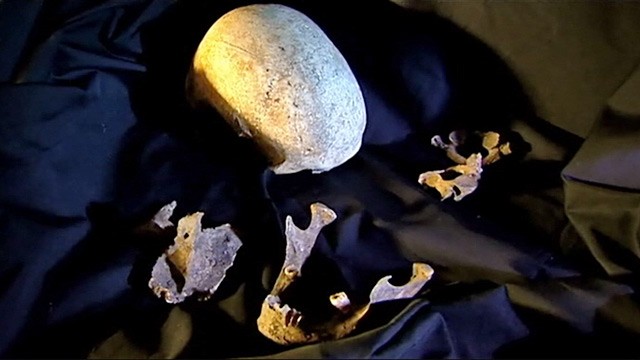
One of the worst droughts in Texas history is helping archaeologists unearth a small piece of American history, a graveyard for freed slaves.
While the heat may be taking a toll on crops, livestock and people's livelihoods, it has helped archaeologists uncover two graves that are believed to have been buried for more than a century.

"This grave was actually uncovered by erosion from the water. It was several feet deep years and years ago," Sgt. Hank Bailey of the Navarro County Sheriff's Office told ABC News Dallas-Fort Worth affiliate WFAA-TV.

Cemeteries were marked and moved before the Richland Chambers Reservoir in Navarro County, Texas, was filled in the 1980s, but this small cemetery without tombstones went unnoticed.

PHOTO: Slave cemetery revealed by Texas drought
A 19th century slave cemetery has been revealed by the recent Texas drought

Human remains were initially discovered in 2009 by boaters when the water level was low, but the water rose quickly and archaeologists and historians have been waiting ever since for the reservoir to reveal the cemetery again.

"It's not one of the great finds of history, but it's important to us on a local level." Bruce McManus, chairman of the Navarro County Historical Commission, told WFAA-TV. "It's one of the lost cemeteries we've been looking for."

The remains that have been found will be reburied elsewhere. For now, investigators are keeping the cemetery's location a secret because they are afraid of looters.

Thursday, June 10, 2010

Rare slave children photo found


A rare photo thought to be of two slave children or just recently emancipated slave children was recently discovered in a moving sale that took place in North Carolina. The photo was possibly taken by a follower of Matthew Brady. Read the full article here.

Monday, February 15, 2010

Richmond to install 16 markers on slave trail

Here's an interesting article on a Richmond, VA project to install markers along the "Richmond Slave Trail". This trail, at just over 2.5 miles, helps trace the slave trade history in the area until 1775. This certainly seems like a worthy project and a story that should be told. Guided tours are available this month though the article does not say if these will continue.

Richmond to install 16 markers on slave trail Richmond Times-Dispatch

Saturday, September 12, 2009

Pre Civil War duel kills anti-slavery Senator


This Sunday marks the 150th anniversary of a California duel between anti-slavery Democratic Senator David Broderick and California Supreme Court Chief Justice David Terry. Despite Broderick being a Democrat he was a leader of that party's anti slavery wing thus causing the rift with Terry, originally from Kentucky. Terry believed the Douglass the anti-slavery men followed was Frederick, the black abolitionist, and not Stephen, the pro slavery candidate for President. As tempers rose a duel was demanded in which Broderick fired first but misfired. Terry then followed with a clean shot to Broderick's chest inflicting a wound that would kill the Senator three days later. Depsite dueling being illegal Terry was later acquitted of murder charges. Terry left politics and joined the Confederate army. He was later killed by a bodyguard after striking Supreme Court justice Stephen Field.


Please read a more in depth article here.